Have you ever been in one of those meetings that are so excruciating that they threaten to suck the marrow from your bones? I have. During one of those long and tortuous meetings, I noticed that we were making no progress at all despite several hours of intense discussion on the topic, let’s call it topic Y. I asked for a few minutes to try an exercise. I think people were willing to try anything at that point, so we went ahead with it.
The exercise I suggested consisted of every person spending 2 minutes writing on a 2×3 card the definition of the word Y, Y being the topic we were addressing. I gathered the cards at the end of the 2 minutes and read out loud the definitions, without even editorializing. The dozen folks in the meeting produced 10 very different definitions for Y. An awkward silence followed. We decided that was a good time to break for dinner.
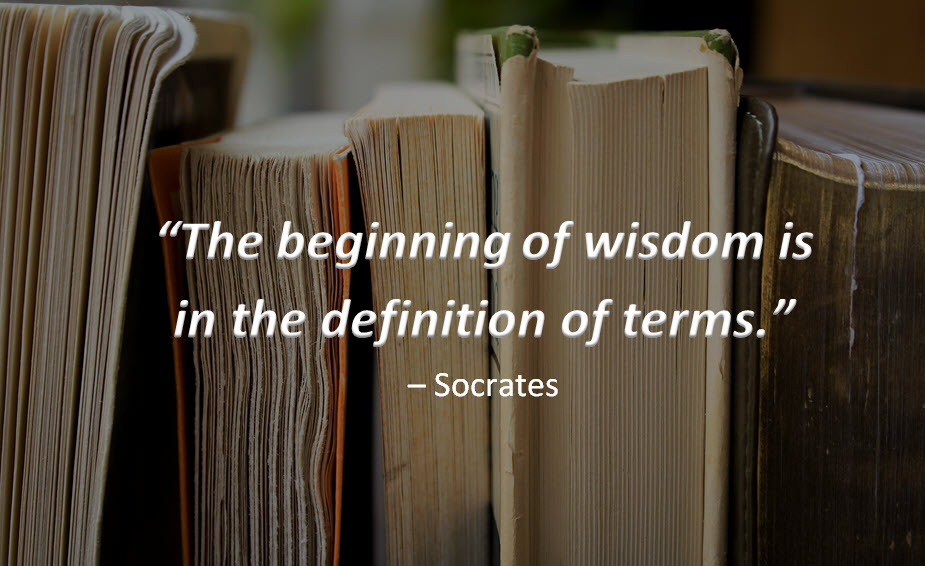
That exercise made me realize the wisdom behind one of Socrates’s (many) great quotes, to the right. One of the things that causes so much confusion, so much angst, so much anger is that we use the same terms and mean different things. (Yes, there are many many other reasons for anger and angst but that’s a story for another time.)
Shakespeare said in Hamlet “Words, words, words”, and this post is a small ode to the power of words. Words have the power to anger us or confuse us. Words also have the power to bring us together, to bring us joy, and to propel us forward in a way that simply would have never been possible without language. And I am thankful for words, even though I often can’t find the ones I’m looking for, and when I do manage to find them, the stringing them together in an optimal way seems beyond me.
So to express my gratitude for words, I’m going to share three words that have come to be in recent history and have opened up new categories, new states of being:
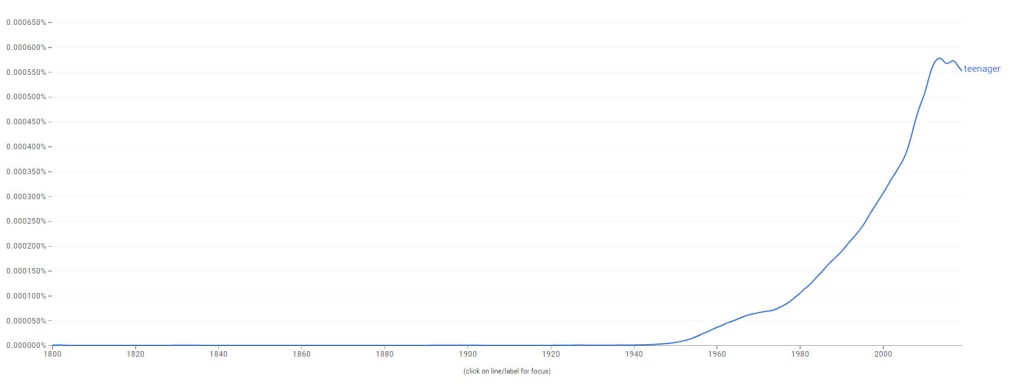
TEENAGERS: as the Ngram to the left shows, the word teenager hasn’t really been used prior to the 1940s, and vaulted into regular use only in recent decades. Before the word “teenager” became a thing, the period of time in life of adolescence, the teenage years, didn’t really exist. Not even 100 years ago, in 1938, 80% of children as young as 14 were working. Back in 1938, you didn’t get to be a teenager, you were a child and then switched to being an adult. Interestingly, the first known use of the word according to Merriam-Webster was 1913, and it definitely took a while for teenagers to be a “thing.” Now teenagers are a “thing” to be reckoned with: in 2020 teens’ spending power was nearly $3 trillion!!!
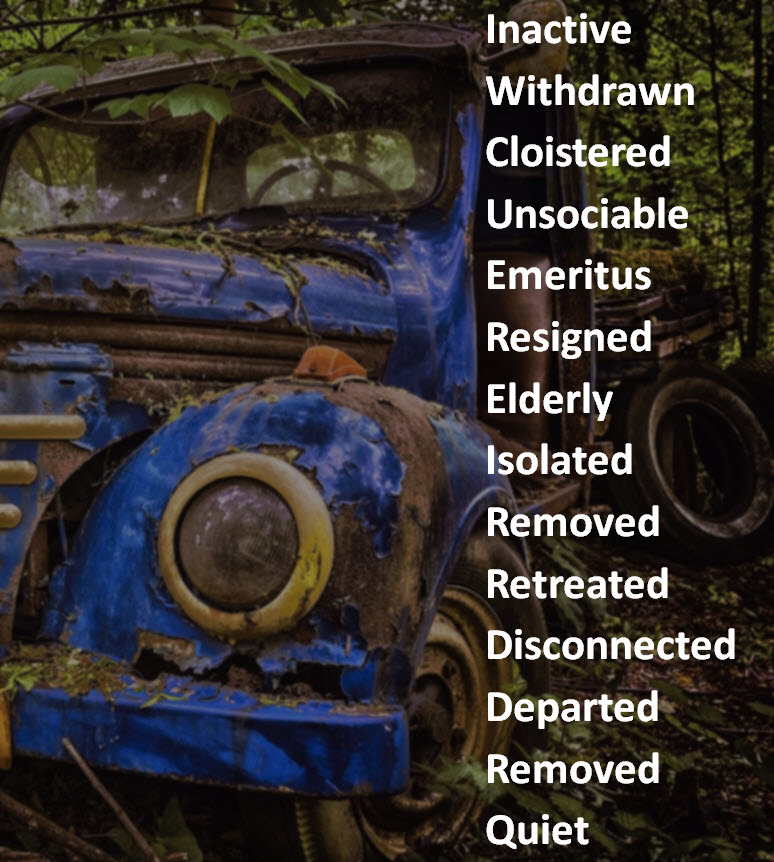
RETIREE: retirement is a period of joy, of jubilation, and of jolliness! And yet the connotations of the word retirement seem to be almost entirely negative, depressing even, as we explored in the past. Just look at the synonyms we detailed in that post for retired (to the right). Ouch! No. Make it OUCH! It boggles the mind, how did the word “retired” get such a bad rap? Janis pointed out that in Spanish, it’s “jubilacion” which sounds, she said, just like jubilation, and that sounds just about right to both of us.
And funnily enough, according to Merriam-Webster, the word retiree came about after the word teenager, in 1935. Can you imagine a world without retirees? And who would have thought that “retiree” would be the new kid on the same block as “teenager”? 😀

ARTIFICIAL INTELLIGENCE: AI is so much in the news today, with so much controversy, some of it for good reasons. Do you know when the term AI was coined? It’s the newest kid on this block/post, with its first known usage coming from a 1955 paper proposing a summer research project that you can read. Do you think the 4 co-authors of the paper (from Dartmouth, Harvard, IBM, and Bell Labs) had any idea that what they proposed then would bring about a new hit song almost 70 years later from a band that would be formed 5 years after their paper came out? 🙂
Can you imagine a world without teenagers? Without retirees? Without AI (which includes word completion, recommendations of music or movies, auto-tagging of photos, etc.)?
Have certain words opened up an opportunity for you that otherwise would not have been an option? Any new words you think are missing and would like to introduce?
For more discussion on this and other topics, visit us at The Endless Weekend.
 The Heart of the Matter
Soon the word “retiree” will diminish in popularity because so many retirees are coming out of retirement to go back to work. We need a new word for those that do. Boomerangs?
LikeLiked by 3 people
With increased longevity, our society needs to rethink the whole concept of how we view our later years. To “retire” literally means to withdraw. It’s a word that probably needs to be erased from our vocabulary. I prefer to call it a new chapter or second life—an opportunity to reinvent oneself. The idea of 30+ years of leisure isn’t appealing to many, not to mention not financially feasible for most. Many people are reinventing themselves later in life. Now we just need companies, governments, and financial institutions to get on board.
LikeLiked by 2 people
It’s an interesting point. Given that we “retired” in our 40s, it was challenging, at times, to tell folks that we’re “retired”: the mental picture people have is of what you said, of folks sitting on their rocking chairs, waiting to die 😳 Good grief! We clearly have pegged that period of time with a misfit word, and I wonder what it means about our perception of what matters. Are we afraid of being idle? https://endlessweekend2019.wordpress.com/2023/01/31/whos-afraid-of-being-idle/
We see this period of life as one where we can do what we want, without pressures of making a living and having to sit through mind-numbing meetings where most participants don’t agree on even the topic of the meeting, and don’t work to resolve it. Good grief x2!
Its funny how few of us appreciate the period of life we have to learn and grow and do what we want without pressures of making a living (the period of time through our teenage years), and when we have a stab at it again, in our “next chapter” we label it “withdraw to a rocking chair on your porch”?
LikeLiked by 1 person
LOL. “Waiting to die!” Isn’t that the truth for many people? I love the work that I do but, at the same time, I’m really looking forward to moving on from my full-time career into a new chapter. There are just so many things I want to do, but I want the flexibility to do them on my own terms and my own time. There will be no rocking chair on the porch for this girl!
LikeLiked by 1 person
This is why I find the word retired/withdrawn so mismatched: it’s about freedom to explore, to try new (or old) things, to grow in the direction you want to go in. Yes, on one’s time.
Why do we tag this period of growth and exploration with “withdrawal”, “resigned”, and “disconnected”? What does it tell us that the teenage audience is so desirable and the next-chapter-explorers… are the “withdrawn”?
LikeLiked by 1 person
I think you’ve hit on the ageism that is so pervasive in our world! Marketers go after the “lucrative” youth market and portray older people as crippled and obsolete. Yet, there is so much wealth and wisdom in the older market that they could be tapping in to.
LikeLiked by 1 person
Which is funny (?) because so much wealth is concentrated in “older” hands and yet, like you said, the lucrative market is the young market. And through some halo effect wisdom is also attached to youth as opposed to the elders?
LikeLiked by 1 person
What an incredible word! I hope it’s by choice and not like “boomerang children” who do it by necessity?
I know of several folks who wanted to continue to work but were forced out due to mandatory retirement ages. What do you think about those age limits?
LikeLike
I love words and I often include definitions of words in posts (see tomorrow’s post in fact) because without having a base of understanding we can’t communicate. As for new words my daughter used the word screenager which I can’t help but love
LikeLiked by 1 person
Screensager: fantastic!
I’m looking forward to your post tomorrow and wholeheartedly agree with you: civilization as we know it is impossible without words, words, words!
LikeLiked by 1 person
👍👍👍👍👍
LikeLike
I love your word-smith-y, deep-diving self, EW! Thanks for all of this. I’ll need to noodle on your question other words because I love a good etymology wormhole. Most of all, thanks for your spot-on description of a laborious meeting, trying to rally the team. Awkward silence = time for a break? Yah…yes, yep! Love it! 🥰
LikeLiked by 2 people
Thank you so much, Vicky! I love the “etymology wormhole”, too, with a passion that allows me to get sucked into almost every one I see: let’s find some that we can explore together?
And, yes, we took an overnight break, which allowed us to completely forget the learning by the next morning 🤪
LikeLiked by 1 person
Love your passion for words…you’re the best, EW! 🥰❤️🥰
LikeLike
A refreshing and enlightening topic. Thank you.
LikeLiked by 1 person
You honor me, thank you, Gerald!
LikeLiked by 1 person
Oh, were we in the same meeting? I swear I have one of those every day, where it seems like we have ten different meetings and purpose’s happening all at the same time. It’s gotten so bad that I start mine with a meeting goal upfront. Why are we here. What’s the purpose, so that we can keep things going!!!! Plus, I love the point of your piece, words and meanings change. Will retiree mean the same thing in 50 years that it does now. I expect not!😊😊😊
LikeLiked by 1 person
We very well may have been… And in 50+ person meetings I often counted how many “man years” were gone forever with nothing to show for them but sadness and despair?
I think it’s a fantastic idea to start meetings either way the purpose stated upfront! Seriously!
And, I’m now curious: what do you think “retiree” will mean in half a century?
LikeLiked by 1 person
Who knows? A working retirement? A volunteer retirement? An RV traveling retirement? Who knows?
LikeLike
First, I love the eye opening way that meeting went! What an ah-ha moment and excellent time for dinner and perhaps a do-over on another day entirely?
As to definitions…I really wonder how we easily solve those dilemmas? We live in a world with diversity of cultures, languages, ideals, beliefs, viewpoints, socio-economic disparities and of course: misinformation. Is there going to be an entirely new course required in schools- Dictionary Definitions 101- although whose book do you choose? Do you go with standard or add even more reading, study and confusion by including the new, trending and often outlier definitions found in places like the UrbanDictionary.com?
Life was certainly easier when you just pointed at something and grunted…;)
LikeLiked by 2 people
You would think that a do-over would have been the right thing to do. The following day, the manager who ran the meeting decided to ignore that happened and forged ahead… which meant another day of accomplishing nothing 🤪
I love how you delve into the heart of the problem! Yes, I pondered on how to solve these problems myself, and the best I could come up with was:
Grunt grunt! 😁
LikeLiked by 1 person
I went back to that conversation and as I scrolled I ran into the cat video you posted in our comment line. It cracked me this time just as much as last time! Thanks for the laugh…again 🙂
LikeLiked by 1 person
Then this day was not wasted, if I managed to bring laughter into the world! I just saw a video of a cat that was pushing a glass slowly towards the edge of the counter, but then the cat saw a human with cupped hands ready to catch the fragile glass. The cat gave an annoyed look and stopped pushing the glass 🤣
On a more serious note, I believe there’s hope: despite all the disparity you mentioned, the misinformation and disinformation that inundates us at times, we HAVE managed to agree on certain definitions. A dollar is a dollar is a dollar and everyone, regardless of their background has the same understanding of what it is (even if its value has different impact on different people’s lives). So on some definitions we agree?
LikeLike
I once had a teaching partner who laboured over every word, and drove me crazy. Your post suggests she was in the right.
LikeLiked by 1 person
Who was it that said “everything in moderation, including moderation”? 🙃
LikeLiked by 1 person
Yes! A good motto for life.
LikeLike
I love words and etymology, but nothing particular is coming to mind at the moment in regards to opening up new opportunities. It brings to mind when I was fresh out of college and applying for job, encountering a title and looking up what it entailed. I think it we navigate life with curiosity, opportunities absolutely can open up to us.
LikeLiked by 1 person
That’s an interesting point: what new job titles have you spotted/are needed in the future to satisfy your interests?
LikeLike
Socrates, Shakespeare, and The Beatles. This post covers it all!
LikeLiked by 1 person
I didn’t notice that… I wish I did and then could have found a band that started with an S instead 🤣
LikeLiked by 1 person
Stones, The Rolling!
LikeLiked by 1 person
Love, love, love it! Sometimes you can get what you want 😁
LikeLiked by 1 person
I hope your experiment of having all the meeting attendees write down their definition of the problem was helpful in the end. I think that’s a great strategy when you’ve got different sorts of people at the table and a problem to solve. I had never realized that the word “teenager” had only been a common word since the 1940’s. And all those synonyms for “retiree”–kind of depressing, especially because retirement is not supposed to be that way. Interesting post!
LikeLiked by 1 person
Thank you, Rhonda! I think retirement is a mind-boggling word: why does it have so many negative connotations when, like you said, it should be a period of wonder and happiness?
The exercise ended up starting the group: there was an underlying assumption that the same word was perceived by everyone as the same. Later, it turned out that even simpler words like “share” had the same issue — people said they “shared” info with others, and you can’t imagine how that meant very different things to different folks… Makes one wonder how frequently that happens?
LikeLike
While I loved my career (elementary teacher), I don’t miss pointless meetings listening to someone yammer on. Right about the time things were thankfully wrapping up, and we could return to the 173 things we needed to do before the next day, someone would raise their hand and ask a question with an obvious answer, allowing the presenter to talk another ten minutes as the rest of the staff pretended not to be annoyed. 🤣
LikeLiked by 1 person
lol, does this ring a bell with you? (Below)
LikeLiked by 1 person
I like the Arthur C. Clark quote, and think of it occasionally as our techie world evolves. I like magic so I guess I take the changes in stride.
Your line: “Back in 1938, you didn’t get to be a teenager, you were a child and then switched to being an adult.” My mother said the same thing, she was child playing hide and seek one week, the next she was an adult wearing dresses and hose and lipstick. Boom, congrats you’re a grown-up now.
LikeLiked by 1 person
I often think of that quote, too, and how our history and our present both seem to reinforce the wisdom behind it… Can you imagine the Connecticut Yankee in today’s court?
And that’s really interesting about your mom: did she ever share what prompted the changeover? Was it an age thing or another event?
LikeLiked by 1 person
I’ve no idea what prompted [forced?] her to change. Maybe peer pressure?
LikeLiked by 1 person
That’d be so interesting to find out: was it peer pressure? Did she turn a certain age when it was “expected”? Did she join a certain org that prompted that? Something completely different?
LikeLiked by 1 person
🤷♀️
LikeLike
So, so interesting, EW! I had no idea about those new kids on the block. This is such a great post that illustrates how powerful words are – both in the exercise and in propelling our curiosity about how, when and why words are introduced! Love it! Grateful for you, EW!
LikeLiked by 1 person
The thanks go to YOU, Wynne, for your generous and encouraging words and for creating such an intriguing set of topics to help guide our thoughts!
LikeLiked by 1 person