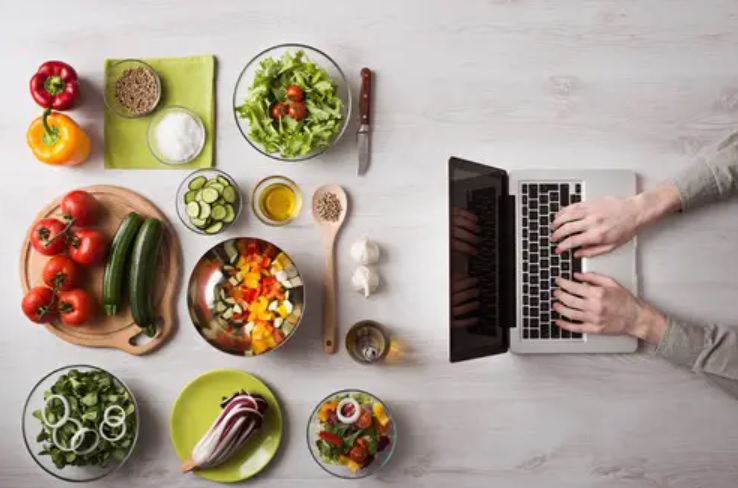
I first heard the term mise en place while watching the television show Worst Cooks in America on the Food Network. Chef Anne Burrell introduced the term to a new season’s cast of recruits: people of various ages and professions who had shown themselves to be inexperienced, inept, or exaggeratedly careless cooks.
At first, I misunderstood. I thought she was saying knees on plots. I pictured the recruits kneeling on something like prayer mats (the “plots”) and swearing allegiance to their commander, Chef Anne, as she pledged to instruct, critique, threaten, cajole, and mother them into becoming competent cooks able to prepare appetizing meals for their loved ones at home.
Soon, though, my scant familiarity with the French language led me to recognize the words she was saying. Mise en place, which translates, everything in place. This foundational culinary principle, conceived in the mid-nineteenth century by French military-veteran-turned-chef Georges Auguste Escoffier, involves an approach to cooking that includes understanding and envisioning an entire recipe completion process before one begins to cook; gathering, measuring, and organizing one’s ingredients and arranging one’s tools; and completing one step in the cooking process at a time, giving full attention to that step and nothing else.
Over time, I have learned to adapt these principles in my own kitchen. Discovering them has made me a calmer, more organized, and somewhat more successful cook. That pleasing result has led me to wonder if mise en place could also be applied in areas of our lives outside of the kitchen.
Mise en Place as an Approach to Life
In his book Everything in Its Place, journalist Dan Charnas suggests that the principle that brought military-styled precision to the kitchen can be employed more broadly to bring order and efficiency to our work, our minds, and our lives. He promises his readers that, “A personal mise-en-place imparts a kind of learned resiliency that, if you practice it, can travel with you from workplace to workplace, from opportunity to opportunity.”
I am a writer. So naturally I wondered if these principles could be applied to a writing practice, whether one writes privately as a form of therapy or publicly with the hope of reaching an audience of readers. Surely not, right? In my years of writing and teaching writing, I’ve learned that writing is an act of discovery, a way of learning, a means of encountering one’s own thoughts. Writing is chaotic. It almost never happens in a straight-line trajectory or in any organized way. Writers draft, revise, edit, re-draft, revise, edit, and proofread again and again, sometimes seemingly without end. The writing process is recursive. It weaves backward and forward, it stalls and restarts, it directs the writer rather than the writer directing it. The act of writing can’t possibly be reined in by the mise en place principles, can it?
As he imagines the application of mise en place beyond the kitchen, Charnas writes, “Over time, mise-en-place begins to reveal itself as a set of values: Apprenticing oneself. Getting to class early, not just on time. Working with intensity. Cultivating a sense of urgency. Remaining alert. Aiming for perfection.”
Ah, yes. Now those are values that can be applied directly to a writing practice. Those are worth a writer’s consideration. I believe that the values Charnas associates with mise en place can be distilled into four guidelines for productive writing.
Mise en Place Values for Writers
1. Apprenticing oneself
Writers should approach their writing as learners. They should view writing as a skill that can be cultivated through experience. They should be willing to take risks, to try new techniques, to change their approach to their subject in the interest of writing more effectively. Writers should never think of themselves as having mastered writing.
2. Getting to class early, not just on time
Not writing is always easier than writing. Writers must develop the discipline to devote time to their practice. They must establish a regular time for writing and show up for it. They must take their writing seriously, even when others around them do not. They must value their own work.
3. Working with intensity, cultivating a sense of urgency, remaining alert
Whether they engage in strictly personal therapeutic writing or seek publication, writers must be willing to break through surface-level writing that may be grounded in cliches and built upon the expected. They must be willing to delve deeply into their subjects, to push past familiar wording and phrasing to discover their own original forms of expression. They must write with the anticipation that they will discover something urgently relevant to themselves or their readers.
4. Aiming for perfection
Writers must recognize that their work is never done. They must strive continually to find exactly the right words. They must structure and re-structure sentences until they express precisely what they mean to say. If they write for an audience, they must edit and proofread tirelessly to give their writing the polish that establishes their credibility to readers. They must aim always for perfection.
While the mise en place principles that ensure success in the kitchen may not apply directly to writing, the values that those principles reflect do. They remind anyone who writes that their pursuit is important, that it is worth the devotion of time and effort, and that it has potential value for others.
~~~~~~~~~~~~~~~~~~
As an English professor with over twenty-five years of experience teaching writing, I want to devote the latter part of my career to sharing the expertise that I have acquired with people beyond the classroom. I want to inform, support, and encourage those who write about their personal experiences in particular—writers of what I call personal nonfiction—whether they write privately for therapeutic benefits or professionally for an audience.
For more on writing personal creative nonfiction and on writing in general,
please visit my blog Person on the Page.
 The Heart of the Matter
Thank you for this, Georgia! I love the intentionality and focus of the ‘mise en place’ methodology for cooking and baking (often because it’s a way to cross-check to make sure I have all of the ingredients) on hand. 😉 I love the application to writing! Thank you for sharing the Dan Charnas book with us. The preparation and effort…and the worthiness of setting the stage to write…allowing the creation to unfold? Very “mise en place’. I see it!
LikeLiked by 3 people
Thank you, Vicki! Yes, I think the mise en place values remind us to take our writing seriously and to honor our craft.
LikeLiked by 1 person
😉 Love it!
LikeLike
What a fascinating post. As Wynne is aware, I love a good cooking analogy for life and this one was interesting to read about. I’ll have to look up more about mise en place and think about how I might apply those principles to my life.
LikeLiked by 2 people
Thank you for reading! I’m going to be taking a food writing course next month, so I’ll be whipping up some new cooking analogies soon.
The idea of mise en place as a way of life has changed my perspective on my life and work. I think it is a useful concept.
Thanks again!
LikeLike
I am one of those hurry-up, haphazard kind of cooks who could easily qualify for a starring role in “Worse Cooks in America”. Once, in a fit of “get-it-rightness”, I employed the mise en place plan and oh my—what a difference it did make! For one brief shining moment, I nearly morphed into a gourmet cook—not quite. but almost. Thanks too, for the pronunciation tip—knees on pots. That helped a lot!
LikeLiked by 1 person
Thank you for reading, Julia! I have always been a haphazard cook, too. I’m getting more organized, though, and it really makes the work of cooking much easier. I’m hoping to get better at it as I continue to apply the mise en place principles.
Thanks again!
LikeLike
I’m still stuck on the mise en place—knees in pots—thing. It reminds me that as a kid, I thought that “Silent Night was suggesting that we should sleep in heavenly peas. What a visual. 😉
LikeLiked by 2 people
Love it! 🙂
LikeLike
So interesting! The wonderful thing about “everything in its place” the completed puzzle is such a beautiful thing. I don’t always look at it that way, but I think that’s why I continue to write — to get that feeling. Thanks for sharing!
LikeLiked by 2 people
Thank you, Brian! I’ve always seen writing as a messy process that couldn’t be systematized. By the values of discipline and taking our writing seriously can surely help us maintain a productive writing practice.
Thanks for reading!
LikeLiked by 1 person
I love this!!!! The only thing I would be iffy about is the perfection thing, but this is a great approach!!
LikeLike
Thank you for reading! I think perfection, especally when it comes to writing, is never attainable but certainly worth reaching for. The most important thing, I think, is to take writing seriously and work at it with some degree of discipline.
LikeLiked by 2 people
What a great post, Georgia! I laughed out loud at, “Not writing is always easier than writing. ” Amen to that! Your description of writing as chaotic and meandering really spoke to me – but then I loved how you applied the Charnas principles to the practice. Brilliant! Thanks for sharing your writing and tips with us!
LikeLiked by 1 person
Thank you, Wynne! I enjoyed beginning with the connection between cooking and writing and discovering, through Charnas, how a set of values can be applied to both.
Thanks for reading.
LikeLiked by 1 person
Yes! ❤ ❤ ❤
LikeLike
I laughed so hard at the image of people bowing down to Chef Anne Burrell. I’m curious, as a professor, what is perfect writing to you personally? Is it a great story, writing to get your personal voice across, etc? Or kind of a mix of all the above?
LikeLike
I don’t know if anyone has achieved perfection in their writing, but I think that excellent writing reflects the writer’s attention to detail and awareness of an intended reading audience. I recently wrote a post on my blog called “Five Qualities of Good Writing.”
For me, those five qualities comprise what I appreciate in what I would call excellent writing.
Thank you for reading!
LikeLiked by 1 person
Georgia, lovely to see a new face and post here on HoTM! Welcome 🙂 Even though I had no idea at the time that there was a fancy french term I learned mise en place waayyyy back in 9th grade home ec class! We were taught exactly what you describe and those lessons have followed me through life, at least in the kitchen but I notice I have much the same sort of “everything in place” attitude in most things I do. I am a very casual writer however, yet I do see hints of the points Charnas makes in my approach. I am quite fond of #3 specifically. I read into that idea the concept of individuality and authenticity. I don’t know any other way to write and what people read is the same as the person they would encounter IRL.
LikeLiked by 1 person
That individuality and authenticity is what some would call a writer’s “voice.” Voice is difficult to define, but so easy to recognize in good writing.
Thank you for reading and for the welcome! 🙂
LikeLiked by 1 person
What a lovely post. I love your creating “mise en place” values for writers. You reminded me of a writer’s seminar I went to with guest speaker Ray Bradbury. He said he continued to rewrite Fahrenheit 451 after it was published and continually revised his play based on it.
LikeLiked by 1 person
Henry James also famously kept rewriting his novels and short stories after they were published. Revision can go on forever.
Thank you for reading!
LikeLiked by 1 person
I didn’t know that Henry James did that too!
LikeLike
It’s probably time for me to start printing your posts and create a book of them. My enjoyment of and commitment to writing has heightened since you showed up. Great post.
LikeLiked by 1 person
Thank you, Jeff. Your encouragement has helped to fuel my writing and solidify my commitment to it. I’m grateful for that.
LikeLike
[I thought I left a comment here, but it seems to be gone. We had a couple of power outages yesterday and all things computer-y seemed to be off. Maybe I didn’t hit the *send* button after all. Not really the point here…]
I just wanted to say that I enjoyed this post and will be contemplating how writing and cooking dovetail together. I am laughing about the idea that “not writing is easier than writing.” I dunno, I am at my happiest when I’m slapping words onto a page. Hence I comment.
Also adore your phrase “writers of what I call personal nonfiction” which is a great way to envision blogging. Well said. I’m smiling.
LikeLiked by 1 person
Hi, Ally. Thanks so much for reading and commenting. I’m glad that you find happiness in writing. I sometimes do, too. But mostly I disappoint myself.
I’m glad you pointed out to me that blogging is a genre of personal nonfiction. I’ve been working on thinking through and developing my definition of personal nonfiction. That helps me a lot.
Thanks again!
LikeLiked by 1 person
Interesting
LikeLiked by 1 person
Thank you so much for the share! I appreciate it.
LikeLiked by 1 person
Your welcome.. you can write me on Josephinefreeman2006@yahoo.com for consultancy ..
LikeLiked by 1 person
One of the central points that I stress to all of my students of culinary arts. Thanks for sharing your use of Mise en Place as it pertains to writing.
LikeLiked by 1 person
Thank you for reading, Daniel.
LikeLiked by 1 person