When I was a young kid, I read a book about a guy who walked across the United States, connecting the Atlantic to the Pacific Oceans. It was hard for me to wrap my brain around the idea, it seemed like such an impossible task. I couldn’t imagine how he could do it.
The details of the walk fascinated me a great deal.
The gist of the book was that anything was possible, you just needed to take the first step and be disciplined. He took backroads through small byways and towns and took his time, relying on the generosity of the people he ran into on his travels. He wrote heavily about the variety of people he met and how they opened their hearts and homes to him. Some viewed him with apathy, others as an oddity, and still others with generosity and openness.
A roadmap to reaching success
Whether it’s been people walking great distances across the country or on trails like the Appalachian Trail or Pacific Crest Trail; climbing large mountains; running marathons, ultramarathon, or triathlons, or even pursuing long-term goals like a college undergraduate or doctorate degree, I’ve long been amused by people tackling large, seemingly insurmountable tasks.
The bigger the task, the smaller the underdog, the better.
I think I liked hearing about endurance activities so much because it has much in common with writing. Like a hiker starting out on a ambitious adventure, writers start out the same way. Whether they’re literary giants, New Times Bestsellers, occasional bloggers, or writer wannabes, we all start out the same way: with a germ of an idea.
From that germ, writers build one idea on top of another and another and another. They write in the wee hours of the morning, during the day, or even late at night when everyone else is asleep. They’re builders with hard hats on the job-site connecting one key idea together with another. It’s like Legos or Lincoln Logs that with a little work connect to form a house or a Star Wars Imperial Star Destroyer.
One piece on top of the other
It’s the way Charles Dickens first presents miserly old Scrooge in A Christmas Carol and slowly introduces the ghost of Jacob Marley and then The Spirit of Christmas Past, Present and Future, teaching him the value of kindness and generosity.
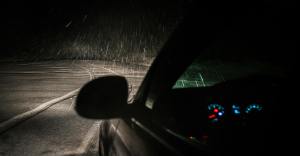
American novelist E.L. Doctorow who wrote twelve books, including Ragtime, Billy Bathgate, The March, and The Book of Daniel, explained the act of writing like this: “[Writing is] like driving a car at night: you never see further than your headlights, but you can make the whole trip that way.”

Seeing just enough to make the drive
Doctorow’s line has long been a favorite of mine: the idea of never seeing further than your headlights, but having the ability to make the whole trip fascinates me. I suspect I’ve found it relatable because it reminds me of one of my first writing jobs. I was working as a county government reporter for a small newspaper with less than 10,000 readers and had to work the late shift one night. I was on the go most of the night and didn’t have time to look out the window. When I finally was done, I walked out into an inch of snow on the ground and a raging blizzard whirling all around me. I could barely see five feet in front of my car and needed to drive about 20 miles on back country roads to get home. I worried about my limited vision and getting stuck in a ditch, but amazingly enough, I was able to make the entire trip home.
The trick was to drive slowly and focus on what I could see in front of me. Whenever I tried to look a quarter of a mile to a half mile in front of me, the blur of snow would give me a headache and I would start to veer off to the side of the road.
Yes, indeed, that’s all it takes to get home or even tell a story . . . one step at a time until you’ve taken the reader all the way from one end of the country to the other. You may start from nothing, but if you’re able to connect enough dots, before you know it, you’ll have something big.
Small steps
Yes, I think that’s what creativity is all about, taking small steps and making connections to help the reader or viewer enjoy the art. I find that’s what us bloggers so, string enough connectors and dots together until the story starts to make sense to our readers and to us.
What do you think? How do go about connecting the dots and telling your story? Do you outline like my Seventh Grade English Teacher lectured or do opt for something else?
…..
Check out my personal lifestyle blog at www.writingfromtheheartwithbrian.com to read other pieces by me. In addition, be sure to follow me on Instagram at @writingfromtheheartwithbrian. Thanks for reading.
 The Heart of the Matter
Wow…the Doctorow quote. New to me and I like it! Your whole post is full of encouraging reminders, Brian. Thank you so much. I love this – no matter who we are as writers, “we all start out the same way: with a germ of an idea.” So good! 🥰
LikeLiked by 4 people
We all start at the same spot!!!! I love the egalitarian effect of writing. It doesn’t matter who you are. Ha, ha.
LikeLiked by 1 person
🥰🥰🥰
LikeLiked by 1 person
Great post. I try to figure out what connection I can make to something, but who knows if I succeed or not….
LikeLiked by 1 person
If you make enough strong connections, from point to point, I think that leads to success. At least, that’s what I’ve seen.
LikeLiked by 1 person
👍👍
LikeLiked by 1 person
I love how you connect the dots. That E.L. Doctorow quote is everything – we don’t need to see the whole picture to move forward.
Sometimes I outline, sometimes I just dive in.
LikeLike
We don’t need the whole picture. We just need to trust that it will come – one step after the other.
LikeLiked by 1 person
I’m also sucker for underdog pursuing seemingly impossible tasks, and I like the idea of viewing blogging through that same lens, telling stories and connecting ideas. This is great, Brian!
LikeLiked by 1 person
I’m a sucker for underdog or cinderella stories. The person that’s not supposed to win who ends up winning it all. Love that.
LikeLiked by 1 person
Yes! I love it, too!!
LikeLiked by 1 person
I prefer to polish the first paragraph so the message to write around is unmistakable before moving forward. Thank you, Brian, for so many helpful tips to keep in mind. 🙂
LikeLiked by 1 person
That quote is fabulous Brian. Often we just have to focus on what’s in front of us to get to the destination, like your snowstorm. Many artists, writers, creatives, allow the process to take hold of them making the final outcome an evolutionary process. On the flip side, for many other things in life we need to have a plan. Because we all know, “if you fail to plan, you plan to fail.” Perhaps it depends on what we’re doing. With writing and many creative endeavours I go with the flow. Yet I plan when it comes to finances and other things that help sustain life.
Love your post. Very thought provoking. I too revere those who managed to accomplish the seemingly impossible.
LikeLiked by 2 people
I think it’s a lot about trust. Trusting that the words will come and lead you to something great. Good advice for writing and life!!!
LikeLiked by 1 person
Wonderful quote and a great post built around it! Yes, we writers have to push to make it forward. Everyone does it a little differently, and it’s solitary, which doesn’t always help. But we move forward, word by word…yours was an encouraging post, thank you.
LikeLiked by 1 person
Aww, thank you Belinda. I hope it was encouraging. And I do actually like that it’s solitary. I think that’s a part I love, something I can do myself and let the curtain down and then show everyone else. My way of entertaining others! Thanks so much!!!
LikeLiked by 1 person
I love this post!! “I think I liked hearing about endurance activities so much because it has much in common with writing” Writing as an endurance sport – yes!
And your incredible description of connecting the dots – not getting too far ahead. Brilliant!!
Such a great post. Thank you for the inspiration and perspective about this crazy business of putting one word in front of another!!
LikeLike
Yea, but Wynne, it’s one thing to write one word after another, but then to mountain climb and take the steps, now that’s something altogether different. Ha, ha. It was a fun one to write. Doctorow’s quote is a cool one.
LikeLike
I enjoyed your analogies. Yes, getting started is the hard part, plus not giving up in the revising process. I have a friend who had her YA novel published and I heard her speak at a writer’s conference. I had a middle grade manuscript I was submitting. I learned my friend had 16 revisions, while I only went through two. No my middle grade manuscript got interest but no contract.
LikeLiked by 1 person
Sixteen revisions. Wow. If I was her, I think I would’ve cried!
LikeLike
It worked for her. I’m sure the later ones were minor. I’m working on a revision where I’m getting rid of one main character and a major overhaul of the plot. It’s difficult.
LikeLiked by 1 person
Yes, that sounds tough! Like killing off a loved one🤪🤪🤪🤪
LikeLiked by 1 person
Not quite 😅 But it’s a struggle.
LikeLiked by 1 person
That is a beautiful quote from Doctorow and so true for writing and for life itself.
The idea of a journey across a country or a large terrain is so appealing and I can see why so many great novels and memoirs have been written using this as its hook.
LikeLiked by 3 people
Yea, I should have played that up more— it really is great advice for life too! Love it Ab!
LikeLiked by 1 person
Outlining? For me, that takes the fun out of writing. I often have a beginning and end in mine before I start. The fun part is making it all work. Do I sometimes write myself into a box? Yes, but that’s part of the creative challenge.
My son has a friend who does endurance running. As someone who hates to run, this idea is not only unattainable for me but something that sounds like torture. Last year he completed a 100-mile run. I don’t know all of the particulars, but you have to finish it within a set time or it doesn’t count.
LikeLiked by 1 person
What a great reminder that small steps lead to the same destination as big ones. I believe consistency and perseverance will win out, yet people often focus on the grand gestures. My approach to writing varies. Sometimes I just sit down and write and see what comes out. Other times, I draft a rough outline.
LikeLike